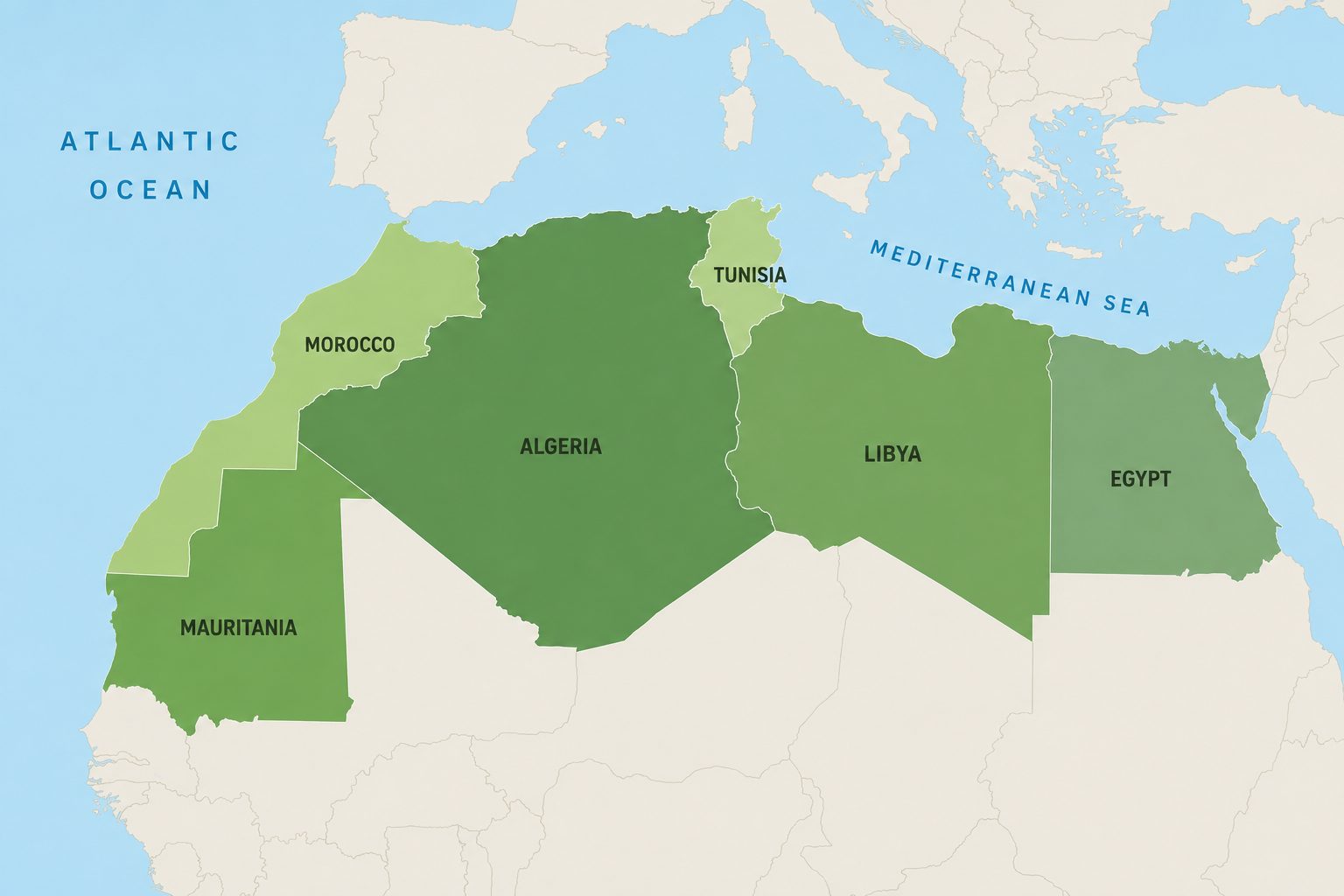
North Africa constitutes one of the most structurally significant geopolitical regions of the African continent. The region primarily includes Morocco, Algeria, Tunisia, Libya and Egypt.
With approximately 260 million inhabitants, North Africa represents close to 20% of Africa’s population and accounts for a significant share of the continent’s economic activity. Its geographic position places it at the intersection of three major geopolitical spaces: Sub-Saharan Africa, the Mediterranean basin, and the Middle East.
This geographic centrality also translates into a major role in global trade flows. The Suez Canal is one of the most strategic maritime passages in the world, with roughly 12% of global maritime trade transiting through this corridor linking the Mediterranean Sea to the Red Sea.
⸻
Regional macroeconomic structures
North African economies display markedly different structural characteristics.
Egypt represents the largest demographic power in the region, with more than 110 million inhabitants. Its nominal GDP is close to $400 billion, supported by a diversified economy combining industry, agriculture, services and revenue generated by activities linked to the Suez Canal.
Algeria possesses an economy largely structured around hydrocarbons, which account for approximately 90% of export revenues and a major share of government income. Its GDP is estimated at around $240 billion, with a population of roughly 45 million people.
Morocco has pursued a strategy of industrial and logistical diversification over the past two decades. Its economy, with a GDP approaching $150 billion, relies on several key sectors including automotive manufacturing, aerospace, agriculture, tourism and phosphate extraction.
Tunisia has developed an industrial base integrated into European value chains, particularly in textiles, mechanical components and services. However, the economy continues to face fiscal pressures and moderate growth, with a GDP of approximately $50 billion.
Libya represents a particular case. Despite a population of around 7 million and some of the largest oil reserves in Africa, its economic potential remains significantly constrained by political instability following the fall of the regime of Muammar Gaddafi in 2011.
⸻
Political systems and institutional stability
The region displays a wide diversity of political systems.
Morocco operates under a constitutional monarchy, characterized by institutional continuity and relative political stability.
Algeria functions as a presidential republic with a political structure strongly centered around state institutions and the security apparatus.
Tunisia has experienced an ongoing institutional reconfiguration, marked by economic pressures and political tensions that have reshaped the balance between executive and legislative powers.
Libya remains characterized by institutional fragmentation, with competing centers of authority and the continued presence of armed groups.
Finally, Egypt has been governed through a strongly centralized political system since the rise to power of President Abdel Fattah el-Sisi.
The political trajectories observed since the Arab Spring illustrate the diversity of institutional developments across the region, ranging from relative stability to transitional or fragmented political orders.
⸻
Strategic resources and energy security
North Africa occupies a central position in the energy geopolitics of the African continent.
Algeria is one of Africa’s leading natural gas producers and a major supplier to several European countries, notably Italy and Spain.
Libya holds Africa’s largest proven oil reserves, although political instability continues to limit the full exploitation of these resources.
Egypt has emerged in recent years as a regional gas hub, particularly through the development of offshore fields in the Eastern Mediterranean.
Morocco possesses a major strategic advantage: the country holds approximately 70% of global phosphate reserves, a resource essential for fertilizer production and therefore for global food security.
Tunisia also possesses significant phosphate resources, alongside an export-oriented industrial sector.
Overall, North Africa accounts for roughly 30% of Africa’s oil production and more than 60% of the continent’s natural gas production.
⸻
Infrastructure and geoeconomic corridors
The region also occupies a key position in logistical corridors connecting Europe, Africa and Asia.
The Suez Canal represents one of the central arteries of global maritime trade. In parallel, the Strait of Gibraltar and several major Mediterranean ports play a crucial role in commercial exchanges linking Europe and Africa.
Morocco has notably positioned itself as an industrial and logistical platform between Europe and Africa, while Egypt aims to strengthen its role as a regional industrial hub built around the Suez Canal economic corridor.
⸻
Structural challenges
Despite its geographic and economic advantages, North Africa faces several structural challenges.
Demographic pressure represents one of the region’s primary long-term issues, particularly in Egypt, where the population increases by approximately two million people per year.
Youth unemployment remains high across several countries in the region, often exceeding 25%.
North African economies also remain heavily dependent on food imports, particularly cereals.
Finally, regional economic integration remains limited. Trade between Maghreb countries represents only a small fraction of their overall trade volumes, which reduces the potential for deeper regional economic integration.
⸻
Conclusion
North Africa today represents one of the most strategically important geopolitical regions of the African continent.
Its geographic position, energy and mineral resources, and its role in Mediterranean trade routes make it a central region in the evolving relationship between Europe, Africa and the Middle East.
In a context of global power reconfiguration, the capacity of North African states to diversify their economies, stabilize their institutions and strengthen regional cooperation will be decisive in shaping their economic and geopolitical trajectory in the decades ahead.
Atlas Observer Research Desk
Atlas Observer’s editorial and analytical desk.